

This fire door inspection checklist is for the routine door-by-door check that a building manager or caretaker carries out between specialist inspections. It takes about three minutes a door.
Fire doors fail quietly. A dropped hinge, a painted-over seal or a closer that has been disconnected will not be noticed until the door is needed. Use one copy of this checklist per door, and record the door’s location or ID so that results can be compared over time. Inspection intervals and who may inspect are set by national rules, so check what applies to your building.
Before you start
- Give every fire door an ID and mark it on a plan. “Third floor, by the lift” stops working at about forty doors.
- Carry a gap gauge or a 3 mm and a 4 mm card, and a torch.
- Open each door fully and let it go. Do not help it close.
The fire door inspection checklist
1. Door leaf
| Check | Pass | Fail | Notes |
|---|---|---|---|
| Certification label or plug present on top or hinge edge | ☐ | ☐ | |
| No holes, splits or damage to the leaf | ☐ | ☐ | |
| No unauthorised alterations: cut-outs, added locks, cat flaps | ☐ | ☐ | |
| Glazing intact and beads secure | ☐ | ☐ | |
| Leaf not warped: sits flat against the stops | ☐ | ☐ |
2. Frame and gaps
| Check | Pass | Fail | Notes |
|---|---|---|---|
| Frame firmly fixed to the wall, no movement | ☐ | ☐ | |
| Gap between leaf and frame even, typically 2 to 4 mm at top and sides | ☐ | ☐ | |
| Threshold gap within the limit for the door type | ☐ | ☐ | |
| No gaps between frame and wall, fire stopping intact | ☐ | ☐ | |
| Stops and architrave secure | ☐ | ☐ |
3. Seals
| Check | Pass | Fail | Notes |
|---|---|---|---|
| Intumescent strips fitted to leaf or frame on top and both sides | ☐ | ☐ | |
| Smoke seals present where required and unbroken | ☐ | ☐ | |
| Seals not painted over | ☐ | ☐ | |
| Seals continuous, no missing sections at hinges or lock | ☐ | ☐ |
4. Hinges and hardware
| Check | Pass | Fail | Notes |
|---|---|---|---|
| At least three hinges, all screws present and tight | ☐ | ☐ | |
| No oil leaks or metal dust at hinges | ☐ | ☐ | |
| Latch engages fully in the keep | ☐ | ☐ | |
| Handles and locks secure and working | ☐ | ☐ | |
| Panic hardware operates with one action where fitted | ☐ | ☐ |
5. Closer and hold-open
| Check | Pass | Fail | Notes |
|---|---|---|---|
| Door closes fully from fully open | ☐ | ☐ | |
| Door closes fully from about 5 cm open | ☐ | ☐ | |
| Closer arm connected and not leaking oil | ☐ | ☐ | |
| Hold-open device releases on alarm test | ☐ | ☐ | |
| Door not wedged or propped | ☐ | ☐ |
6. Signage
| Check | Pass | Fail | Notes |
|---|---|---|---|
| “Fire door keep shut” or equivalent sign in place | ☐ | ☐ | |
| Signs legible on both faces where required | ☐ | ☐ |
What counts as a fail
| Finding | Why it matters | Typical fix |
|---|---|---|
| Door does not latch from 5 cm | An unlatched door will be pushed open by fire pressure | Adjust closer, ease leaf, check latch alignment |
| Gap wider than the limit | Smoke and flame pass before the seal can expand | Rehang, pack hinges, or replace leaf |
| Seal missing or painted | Seal cannot expand to close the gap | Replace seal |
| Door wedged open | The door is not a fire door while it is open | Remove wedge, fit an alarm-linked hold-open if needed |
Gap limits depend on the door’s certification. Where the manufacturer’s data is available, use it in preference to general figures.
Keep a record per door
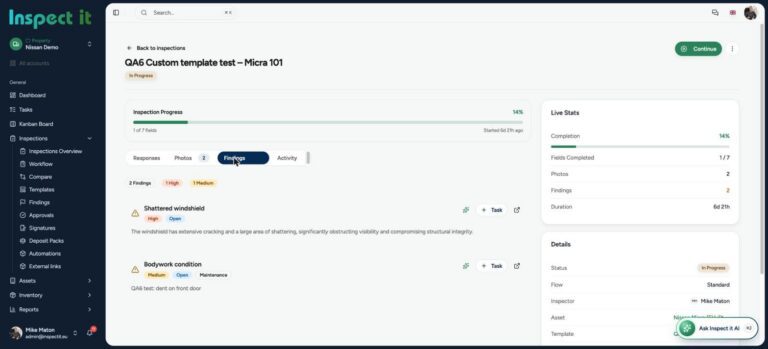
The value of fire door inspections is in the history: which doors keep failing, how long repairs take, which floors are neglected. A paper sheet per door per quarter becomes a filing problem quickly. In Inspect it each door can be an asset with its own inspection history, and each fail becomes a task. See the asset inspection guide for how asset-based inspections work, and the full fire safety inspection checklist for the rest of the walk-round.
Frequently asked questions
How often should fire doors be inspected?
It depends on national rules and the building type. Common practice is every three to six months, and monthly for heavily used doors or in higher-risk buildings.
What gap is allowed around a fire door?
Many door certifications specify 2 to 4 mm at the top and sides. The threshold gap varies by door type. Always follow the manufacturer’s certification data where available.
Who can inspect a fire door?
Routine checks can be done by a trained building manager or caretaker. Detailed inspections and repairs should be carried out by a competent person with fire door training.
See it on one of your own buildings
Run one real inspection with us and get the finished report before the call ends.