

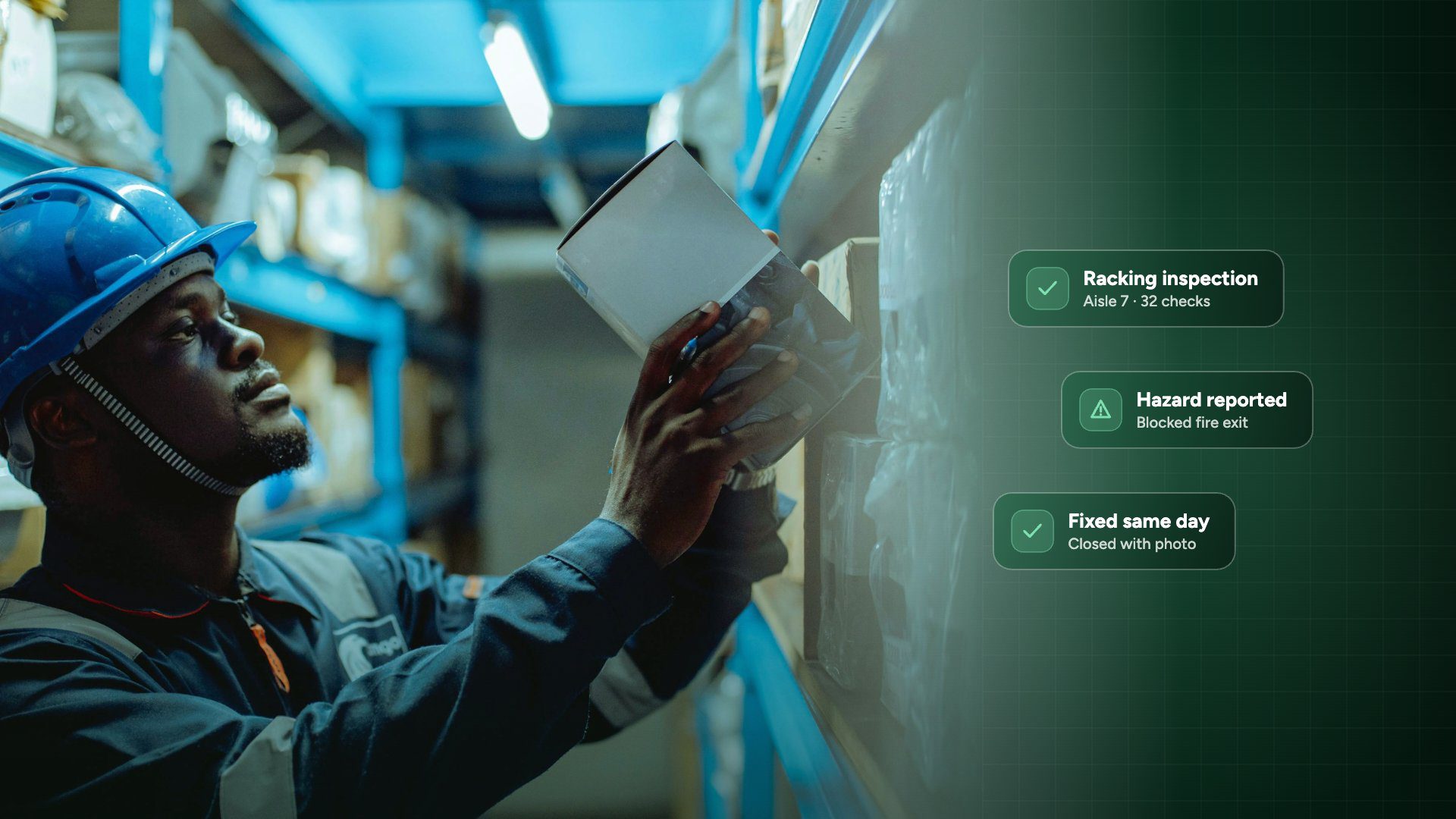
Most warehouse accidents start with something small that nobody wrote down: a bent upright, a forklift with a worn chain, a fire exit blocked by pallets on a busy afternoon. A regular, structured safety inspection catches these before they hurt someone.
This guide sets out what a warehouse safety inspection should cover, how often to run each check, and how moving from paper to a mobile app makes the checks faster and the follow-up easier to prove.

What a Warehouse Safety Inspection Should Cover
Walk the building in the same order every time, starting at the goods-in doors and finishing in dispatch. Cover these areas:
- Racking and storage. Damaged uprights and beams, missing beam locks, overloaded bays, load notices visible, nothing stored on top of the racking.
- Forklifts and other lifting equipment. Pre-use checks completed; tyres, forks, chains, brakes, horn and lights working; seat belts worn.
- Walkways and traffic routes. Pedestrian routes marked and clear, mirrors and barriers in place, no spills or loose wrapping on the floor.
- Loading docks. Dock levellers working, wheel chocks or vehicle restraints used, dock edges protected, lighting adequate.
- Fire safety. Exits and escape routes clear, extinguishers in place and in date, sprinkler heads not blocked by stock, call points accessible.
- Electrical and charging areas. Battery charging area ventilated, cables undamaged, no overloaded sockets.
- Hazardous substances. Chemicals labelled and stored correctly, spill kits stocked, safety data sheets available.
- People and PPE. Hi-vis and safety footwear worn, manual handling aids available and used, first aid kits stocked.
How Often to Check What
Not everything needs checking every day. A simple schedule keeps inspections short enough that they actually happen:
- Every shift: forklift pre-use checks, walkways and fire exits clear, spills dealt with, dock area safe.
- Weekly: visual racking check by a trained member of staff, extinguishers in place, first aid and spill kits stocked, lighting working.
- Monthly: a full site walk-round with the complete checklist, including the charging area and chemical storage, plus a review of open actions.
- At least once a year: an expert racking inspection by a qualified inspector, plus the statutory examinations your lifting equipment needs.
In the UK, HSE guidance (HSG76) and the storage equipment association SEMA both recommend regular in-house racking checks and an expert inspection at least every 12 months. Check the rules that apply in your country and build the frequencies into your checklist.

Why Paper Inspections Fall Short
Paper checklists are better than nothing, but they have three weaknesses that show up in almost every warehouse:
- No proof. A tick on a sheet shows someone signed it, not what they saw. Without a photo, a damaged upright reported on Monday is hard to compare with what is there on Friday.
- Actions get lost. The issue is written down, but nobody is clearly responsible for fixing it and there is no deadline.
- Patterns stay hidden. When the same aisle is damaged every month, or one site always scores lower, nobody notices because the sheets sit in a folder.
How Digital Inspections Make Warehouses Safer
Moving inspections onto a phone or tablet fixes those weaknesses without making the checks longer. With logistics inspection software such as Inspect it, your team can:
- Follow the same checklist every time, with required questions so nothing is skipped.
- Capture evidence on the spot: time-stamped photos, voice notes and signatures, linked to the exact aisle or dock.
- Work offline. Large steel buildings often have poor signal. Inspections save on the device and sync when the connection returns.
- Turn every failed item into an action with an owner and a deadline, then close it with an after photo.
- See every site in one dashboard, with scores over time, open actions and repeat issues.
- Share a clear PDF report with management, insurers or auditors in seconds.
Getting Started in One Week
- Day 1: Take your current paper checklist and remove anything nobody actually checks. Add any of the areas above that are missing.
- Day 2: Build it as a digital template and mark the critical items, such as blocked fire exits and damaged racking, that should fail the inspection on their own.
- Day 3: Run it yourself on one shift and time it. Aim for 15 to 20 minutes for a daily check.
- Days 4 and 5: Train the supervisors who will run it and agree who fixes what.
- End of the week: Review the first results together and adjust the checklist.

Warehouse Safety Inspections: Common Questions
Who should carry out warehouse safety inspections?
Daily and weekly checks are usually done by trained supervisors or team leaders. Racking needs an expert inspection at least once a year, and lifting equipment needs examination by a competent person as the law requires.
How long should a daily warehouse inspection take?
Around 15 to 20 minutes for a typical site. If it takes much longer, split it into separate daily and weekly checklists.
Can forklift pre-use checks be done on a phone?
Yes. A short digital pre-use checklist takes a couple of minutes, records who checked which truck, and alerts a manager straight away if an item fails.
What should happen to the issues we find?
Each failed item should become a task with an owner, a deadline and a photo. In Inspect it, the task stays open until someone closes it with an after photo, so you have a complete record for audits.
Make Your Next Inspection a Digital One
A safer warehouse comes from checks that happen every time and issues that get fixed quickly. Inspect it gives your team the checklist, the evidence and the follow-up in one app.
Start a 14-day free trial with no credit card needed, or see how warehouse and fleet teams use Inspect it on our logistics inspection page.
Explore next: Logistics inspection software. See how warehouse and fleet teams run vehicle, dock and safety checks with Inspect it.