
Every experienced boat owner has a moment, usually somewhere between the third and tenth year of ownership, where they realise they can’t quite remember when they last changed the impeller. Or the fuel filter. Or checked the anodes. There’s a notebook somewhere, probably. There were photos on an old phone. There was that one email to the yard. And now there’s a boat in front of you, and none of the information you need is where you need it.
This isn’t a failure of discipline. It’s a failure of tools. The traditional paper logbook was designed for a world that no longer exists. It was built for a time when boats were simpler, ownership was longer, and nobody expected to pull up three seasons of maintenance history on a wet afternoon at the slip.
At Inspectit, we built our platform around a different idea. What if inspecting your boat was as easy as talking about it, and what if something smart was listening, logging, and watching for patterns across every inspection you’d ever done?
The Problem With How Owners Actually Inspect Boats
Ask ten owners how they track their boat’s condition and you’ll get ten different answers. A paper logbook in the galley. A note on their phone. Photos scattered across their camera roll. Receipts in a shoebox. A spreadsheet that was updated faithfully for two seasons and then abandoned.
The result is predictable. Information exists, but it’s not searchable, not comparable, and not connected. You can’t easily ask “when did I first notice that vibration?” or “how often have I had to top up the coolant this year?” And those are exactly the questions that separate minor issues from expensive surprises.
Meanwhile, inspecting a boat properly is already a lot of work. By the time you’ve checked the engine bay, the bilge, the rigging, the electrics, the through-hulls, and everything else, the last thing you want is to sit down and write it all up. So most owners don’t. The inspection happens, the findings stay in your head, and two months later you’ve forgotten what you saw.
How Voice-Based AI Inspections Change That
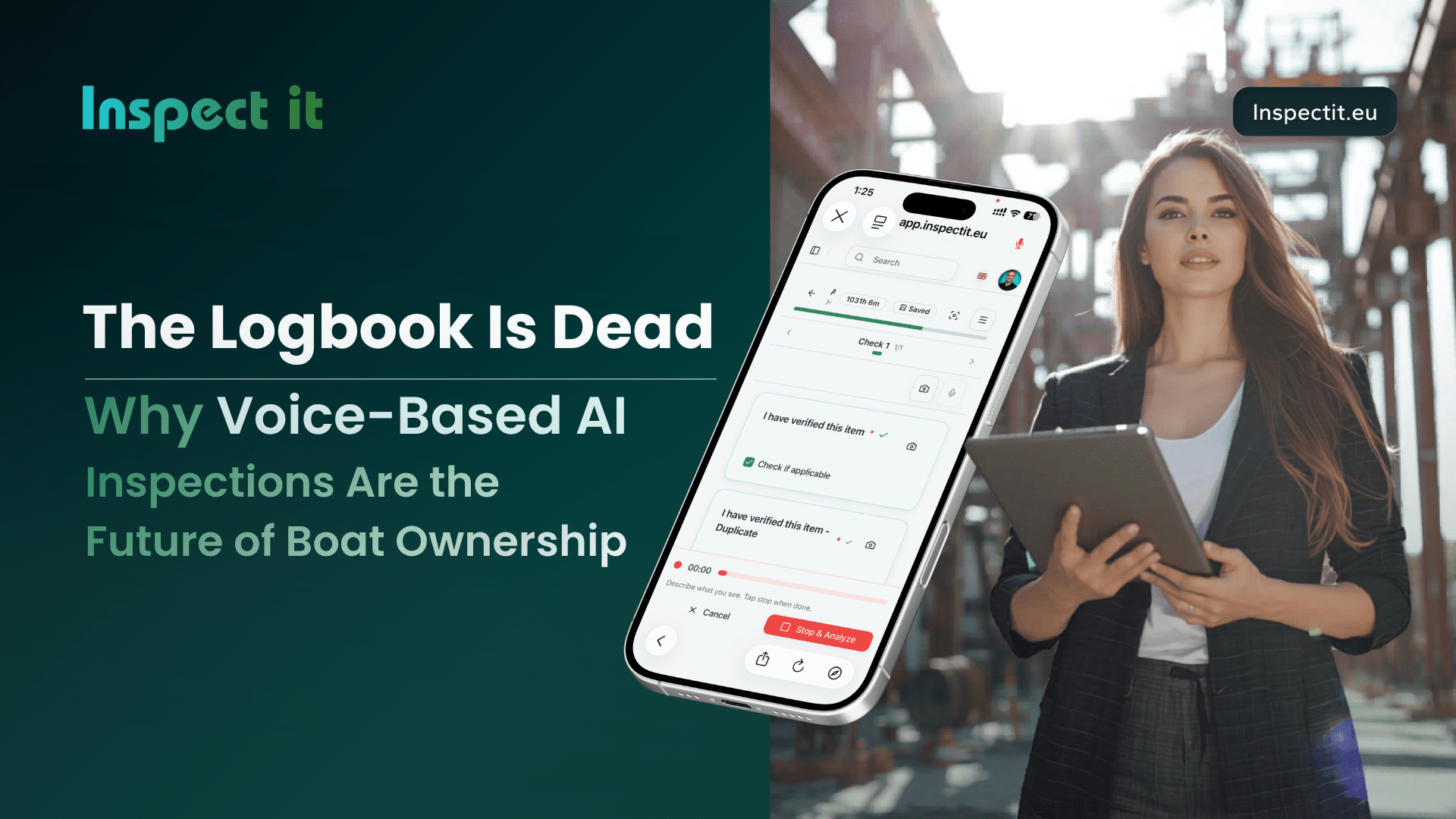
Inspectit’s approach is simple: you walk your boat, and you talk. Engine bay looks clean, oil level good, slight weep on the starboard water pump. Just describe what you see, in your own words, as you move through the vessel. The app records your voice notes, and the AI handles the rest.
Behind the scenes, those notes are transcribed, structured, and logged against the right systems on your boat. A comment about the water pump gets filed under the engine. A note about a chafed sheet gets filed under the rigging. A mention of a slightly stiff seacock gets flagged, timestamped, and tied to that specific through-hull.
What used to be half an hour of post-inspection paperwork becomes the inspection itself. You stop writing things up because you were already saying them.
Why AI Matters More Than the Voice Interface
Voice input is the convenient part. The AI is the genuinely useful part.
Because every inspection you do is logged and structured, the system builds up a picture of your boat over time, and it starts to notice things you wouldn’t. That slight weep on the water pump three months ago that you mentioned in passing? When you mention it again today, the app flags that this is the second time, points you back to the earlier note, and suggests it’s worth a closer look.
The real value of a well-kept inspection history isn’t any single entry. It’s the pattern. Issues that develop slowly are the ones that cost owners the most money, precisely because they’re invisible from any single moment in time. A bilge pump running a little more often than last month. A battery that takes a little longer to reach full charge than it did in spring. A diesel that’s harder to start on cold mornings than it used to be. None of these are alarming on their own. All of them matter when you can see the trend.
Reminders That Actually Reflect Your Boat
The other thing a good inspection history unlocks is genuinely useful reminders.
Generic maintenance calendars, the kind that tell you to change your oil every 100 hours or service the winch every season, are fine as far as they go, but they don’t know your boat. Inspectit’s reminders are built from what you’ve actually logged: the last time you inspected the rigging, the last time you flagged the anodes, the last time you checked the fire extinguishers. If you haven’t done it in a while, the app tells you. If something you’ve flagged before is coming due for re-inspection, the app tells you that too.
The difference is that the reminders feel relevant, which means you actually act on them. A notification that says “you haven’t checked the starboard engine anodes since April, and you flagged them as wearing fast last time” is a completely different thing from a generic “time for spring maintenance!” popup.
Works for a 22-Foot Sailboat Just as Well as a 40-Metre Motor Yacht
One of the things we deliberately designed for from the start was scale in both directions.
For owners of smaller boats (22 to 40 feet): You probably don’t need a complex maintenance management system. You need a way to remember what you saw last time, catch things before they grow, and stay organised without turning ownership into a second job. A five-minute voice walkthrough every few weeks gives you more structured data on your boat than most owners of much larger vessels have ever had.
For mid-size cruisers and motor yachts: Systems are more complex, inspections take longer, and there’s more to keep track of. Being able to dictate findings as you go, rather than writing them up afterwards, makes thorough inspections realistic instead of aspirational. And the history becomes genuinely valuable for pre-season planning, yard visits, and eventual resale.
For superyachts: The captain and crew likely already have systems for inspections, but owners often want their own independent record. Inspectit gives the owner their own voice-driven inspection log, separate from the ship’s maintenance management system, built for how owners actually engage with their vessel.
The rigour doesn’t change. What changes is how much friction sits between “I noticed something” and “it’s logged, tracked, and will be surfaced again when it matters.”
The Case for Talking to Your Boat
Paper logbooks were a good solution to a problem that no longer looks the same. Owners today move between vessels, keep boats far from where they live, share ownership with partners or family, and increasingly expect their tools to do some of the thinking for them.
An inspection you never write down might as well not have happened. A voice note that gets automatically logged, categorised, and connected to everything else you’ve ever noticed about the same part of the boat? That’s a record that actually works for you, quietly, in the background, across every season you own the vessel.
If you’ve been meaning to get more organised about how you track your boat’s condition, and the usual tools haven’t stuck, Inspectit is worth a look. Walk the boat. Talk as you go. Let the AI handle the rest.
Your next inspection shouldn’t take longer than the inspection itself. Start talking to your boat.